UK PRICE INDEX · JUNE 2026 · DATA REPORT
UK Broadband Price Index 2026: What People Actually Pay
What UK homes and businesses really pay for broadband in 2026: average bills, prices by speed tier, the April rises in full, and exactly how much a switch can save you.
Written by Dr Alex J. Martin-Smith · Reviewed by Adrian James · Published 11 June 2026 · Next review within 90 days · ~8 minute read
Prefer to read offline? Download the free PDF report: UK Broadband Price Index 2026 (5 pages). No signup, no email, just the report.
The quick answer
The average UK household pays around £34.50 a month for broadband (MoneySuperMarket survey, 2026). Entry full fibre starts in the high teens, a typical 150 Mbit/s plan sits in the low-to-mid £20s, and gigabit lands in the £25 to £40 range for new customers. Prices fell about 6% in real terms in the year to September 2025 (Ofcom), but those falls go to switchers, not loyal customers paying a £7 to £9 out-of-contract premium.
Key facts · verified June 2026
- £34.50 average monthly bill (MoneySuperMarket survey, June 2026).
- 6% real-terms price drop in the year to September 2025 (Ofcom Pricing Report 2026); faster tiers fell most.
- £329 top switcher saving per year (Uswitch); typical range £184 to £329 (Broadband Genie).
- April 2026 rises: most major providers raised prices by a fixed £3 to £4 a month, depending on provider and contract cohort.
- 28% of customers are now out of contract and paying the loyalty penalty (Ofcom Pricing Report 2026).
- Social tariffs from £12.50 a month can save around £200 a year for eligible households.
What people actually pay
There is a big gap between the advertised price of a new deal and what the average bill actually is, because millions of households are out of contract and paying a loyalty penalty. The chart below shows the typical monthly price range for a new-customer deal at each speed tier.
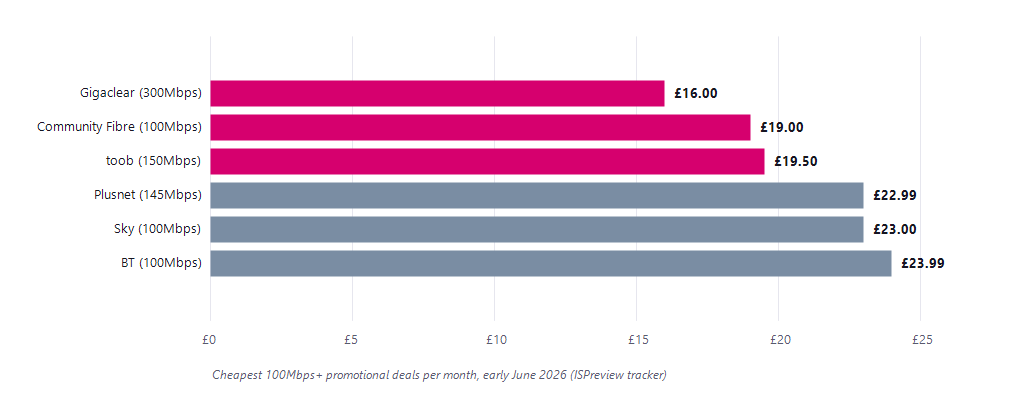
The cheapest broadband in the UK
Prices vary street by street. See the real deals at your postcode, ranked by total contract cost, not headline price: compare now.
- Entry full fibre from altnets: from around £17 to £23 a month for 100 to 160 Mbit/s, subject to availability at your address.
- Social tariffs: £12.50 to £24 a month for households on Universal Credit, Pension Credit and other qualifying benefits, with the cheapest around £12 to £15.
- Broadband and TV bundles: bundling saves £26 to £48 a month versus buying the same services separately, per Ofcom.
The April 2026 price rises
Since January 2025, Ofcom has banned percentage and inflation-linked mid-contract rises on new contracts. Every rise is now stated in pounds and pence at sign-up. In April 2026 most major providers raised prices by a fixed £3 to £4 a month, depending on provider and contract cohort.
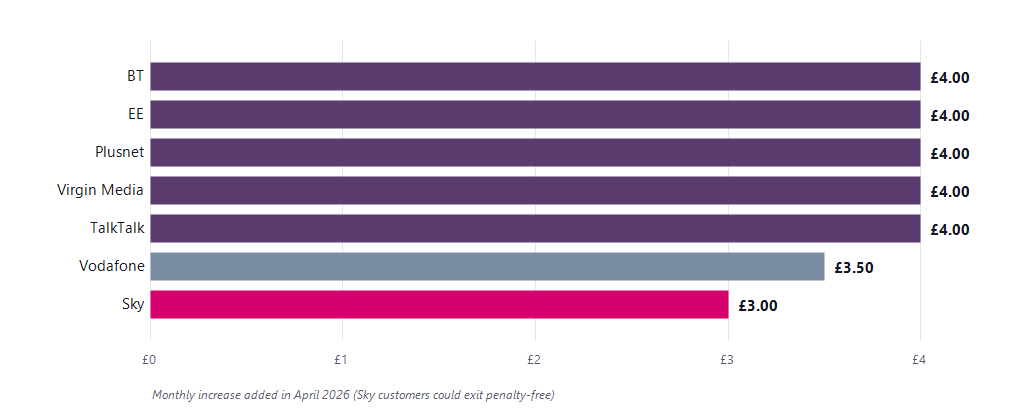
| Provider | April 2026 rise | How it applies |
|---|---|---|
| BT | £4/mo | Contracts from 31 Jul 2025; £2 TV, £1 landline-only |
| EE | £4/mo | As BT; £2 TV, £2.50 mobile |
| Plusnet | £4/mo | Contracts from 5 Aug 2025 |
| TalkTalk | £4/mo | £4 from 16 Nov 2025; £3 for the earlier cohort |
| Virgin Media | £4/mo | £4 from 2 Oct 2025; £3.50 for 9 Jan to 1 Oct 2025 |
| Vodafone | £3.50/mo | £3.50 from 12 Nov 2025; £3 for the earlier cohort |
| Sky | £3/mo | Outside contract terms; 30-day right to leave |
NOW Broadband sits outside this April cycle: its rise has historically taken effect in July (£3 a month, with a 31-day right to leave). Older contract cohorts may face different rises, and some legacy contracts still carry inflation-linked clauses being phased out. Several altnets, including Zen and YouFibre, guarantee no mid-contract rise during the term, and social tariffs are exempt. For escalation rights when a rise lands, see our guide: leave your broadband contract early.
The loyalty penalty, and how to beat it
The single biggest factor in your broadband bill is not your speed or your provider, it is whether you are still in contract. Prices fell about 6% in real terms in 2025, but those falls go to switchers, not to loyal customers who let their deal lapse.
| Measure | Figure | Source |
|---|---|---|
| Out-of-contract premium | £7 to £9 / month more | Ofcom Pricing Report 2026 |
| Customers out of contract | 28% | Ofcom Pricing Report 2026 |
| Typical switcher saving | £184 to £329 / year | Broadband Genie; Uswitch |
| Real-terms price change 2025 | Down 6% | Ofcom (faster tiers fell most) |
Four ways to pay less in 2026
- Compare on total contract cost, not headline price. Add the monthly price, setup fee, any voucher and the published April rise across the full term. Two deals at the same starting price often end up very different.
- Switch the moment you are out of contract. That is where the savings are. Out-of-contract customers pay £7 to £9 a month more for the same product.
- Check the altnets, not just the big brands. Where a second network reaches your street, entry full fibre can start in the high teens, well below the national average bill.
- Check social-tariff eligibility. If anyone in the household receives a qualifying benefit, a social tariff from £12.50 can save around £200 a year.
The wider statistical backdrop, coverage, speeds and switching, lives in the companion reference: UK broadband statistics 2026.
Why overlapping networks cut prices, street by street, is the story of UK broadband market share 2026.
Questions people ask
How much does the average UK household pay for broadband in 2026?
Around £34.50 a month, according to MoneySuperMarket's June 2026 survey. That average blends in-contract deals, out-of-contract premiums and a mix of speeds, so new-customer prices at any given tier are typically lower.
Have UK broadband prices gone up or down in 2026?
In real terms, average broadband prices fell about 6% in the year to September 2025 (Ofcom), with the biggest falls on faster tiers. Most major providers then applied fixed £3 to £4 monthly rises in April 2026 to their newest contract cohorts, but new-customer deals remain competitive, especially from altnets.
How much did broadband prices rise in April 2026?
BT, EE, Plusnet, TalkTalk and Virgin Media raised broadband by £4 a month for their newest cohorts; Vodafone by £3.50; Sky by £3 outside contract terms with a 30-day right to leave. Exact amounts depend on when you signed and which services you bundle.
How much can I save by switching broadband?
Typical switcher savings run from £184 to £329 a year (Broadband Genie and Uswitch). Out-of-contract customers pay £7 to £9 a month more than in-contract equivalents for the same product (Ofcom Pricing Report 2026), so switching at contract end is the fastest saving for most homes.
What is the cheapest broadband deal in the UK right now?
Entry full fibre from altnets starts from around £17 to £23 a month for 100 to 160 Mbit/s where available, and social tariffs from £12.50 for eligible households. Prices vary sharply by postcode; a live comparison is the only reliable answer.
About this report
This report is part of the BroadbandSwitch.uk 2026 Guide Library, published by BroadbandSwitch.uk, the consumer arm of the SearchSwitchSave network. Average-bill and market figures are clearly separated from advertised new-customer prices, and the April 2026 rises were verified against each provider's own announcements. Our approach to evidence and corrections is documented in the methodology and trust hub, and every published correction appears in the corrections log.
Take it with you: download the free 5-page PDF report, including both charts, the April rises table and full sources.
Citing this report: BroadbandSwitch.uk. (2026, June 11). UK broadband price index 2026: What people actually pay. SearchSwitchSave. https://broadbandswitch.uk/reports/uk-broadband-price-index/
Sources
- Broadband Genie. (2026, January 7). The true cost of loyalty: Broadband switching study. https://www.broadband.co.uk/broadband/help/switching-study
- BT Group plc. (2026). Our approach to our annual price change 2026. BT Group Newsroom. https://newsroom.bt.com/
- EE. (2026). Our approach to EE and BT price changes in 2026. EE Newsroom. https://newsroom.ee.co.uk/
- MoneySavingExpert. (2026). Cheap broadband and phone deals. https://www.moneysavingexpert.com/broadband-and-tv/cheap-broadband/
- MoneySuperMarket. (2026, June 5). Compare broadband deals, June 2026. https://www.moneysupermarket.com/broadband/
- Ofcom. (2024). Ofcom bans mid-contract price rises linked to inflation. Office of Communications. https://www.ofcom.org.uk/phones-and-broadband/bills-and-charges/ofcom-bans-mid-contract-price-rises-linked-to-inflation
- Ofcom. (2026, February 26). Pricing and consumer engagement: Trends in the UK communications sector. Office of Communications. https://www.ofcom.org.uk/phones-and-broadband/bills-and-charges/pricing-and-consumer-engagement
- Sky Group. (2026). An update on our prices. https://www.skygroup.sky/
- TalkTalk. (2026). Annual price changes and CPI. https://www.talktalk.co.uk/legal/annual-price-change
- Uswitch. (2026, February). Broadband price rises and how much you can save by switching. https://www.uswitch.com/broadband/
- Virgin Media. (2026). Our annual price change explained. https://www.virginmedia.com/help/annual-price-change
- Vodafone. (2026). Annual price changes. https://www.vodafone.co.uk/pricechanges
The lowest advertised price is not the cheapest deal; total contract cost is. And the fastest saving available to most homes is simply switching the day your contract ends. Prices are point-in-time and were current as of 11 June 2026; specific monthly prices change daily and vary by postcode.