UK DATA REFERENCE · JUNE 2026 · STATISTICS
UK Broadband Statistics 2026: The Numbers, Verified
The state of UK broadband in one place: coverage, speeds, prices, switching, complaints and the mobile picture. Every figure is sourced and dated, so you can cite it with confidence.
Written by Dr Alex J. Martin-Smith · Reviewed by Adrian James · Published 11 June 2026 · Next review within 90 days · ~10 minute read
Prefer to read offline? Download the free PDF report: UK Broadband Statistics 2026 (6 pages). No signup, no email, just the report.
The quick answer
On Ofcom's latest interim data (Spring 2026), full fibre reaches 82% of UK homes (24.9m premises) and gigabit-capable networks reach 89% (27.1m). The average UK home has a 285 Mbit/s maximum download available, up 28% on 2024. One Touch Switch passed two million switches in its first 16 months, complaints sit at historic lows, and 97% of the UK has outdoor 5G from at least one operator.
Key facts · verified June 2026
- 82% full-fibre ready: 24.9m premises on Ofcom Spring 2026 (January 2026 data); thinkbroadband's live tracker put full fibre at 84.6% on 7 June 2026.
- 285 Mbit/s average max download, up 28% on 2024 (Ofcom Connected Nations 2025, July 2025 data).
- 2 million+ One Touch switches since September 2024 (Ofcom, to end 2025).
- 47% full-fibre take-up where available, equating to 12.4m connections (Ofcom Spring 2026).
- 583 GB data per connection per month, rising to 738 GB on full-fibre lines (Ofcom CN2025).
- Copper switch-off: final PSTN retirement on 31 January 2027; copper withdrawn for new orders as each exchange passes 75% full-fibre coverage.
Coverage and infrastructure
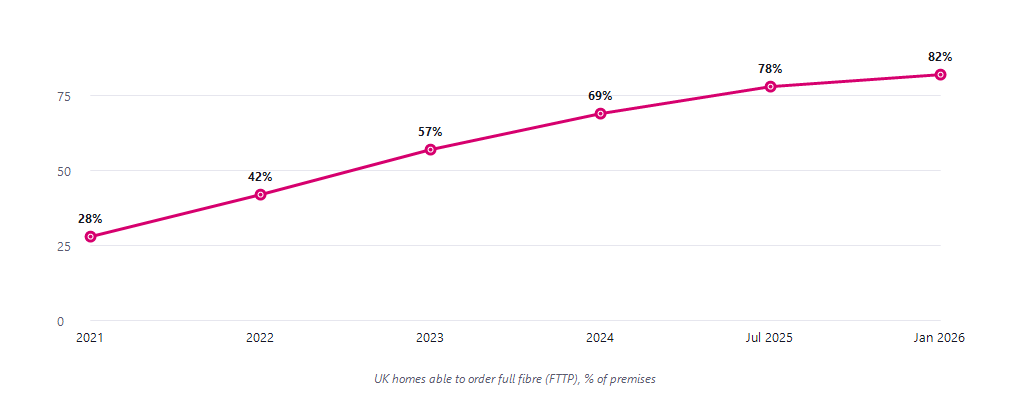
On Ofcom's latest interim data (Spring 2026), full fibre reaches 82% of UK homes and gigabit-capable networks reach 89%. thinkbroadband's live tracker put full fibre a little higher at 84.6% on 7 June 2026; Ofcom remains the official baseline. The UK is in the final stretch of its full-fibre build, from a quarter of homes in 2021 to more than four in five today.
| Measure | Latest figure | Source and date |
|---|---|---|
| Full fibre (FTTP) | 82% · 24.9m homes | Ofcom Spring 2026 (Jan 2026 data) |
| Gigabit-capable | 89% · 27.1m homes | Ofcom Spring 2026 |
| Superfast (30 Mbit/s+) | 98% | Ofcom Connected Nations 2025 |
| Full-fibre take-up | 47% where available | Ofcom Spring 2026 (12.4m connections) |
Three networks dominate: Openreach (22.5m premises, about 67% of the UK), Virgin Media O2 (18.7m, all gigabit-capable) and the altnets combined (19.7m per INCA). These overlap heavily, so are not additive. For the brand and network map, see our UK broadband market share 2026 report and the wholesale network matrix.
The copper switch-off
The UK's old copper phone network (PSTN) is being retired, with final switch-off on 31 January 2027. As each exchange passes 75% full-fibre coverage, copper is withdrawn for new orders, and legacy line costs are rising steeply through 2026. Our dedicated guide covers the timeline: copper switch-off 2027.
Speeds and how we use them
The average UK home has far more speed available than two years ago, and uses far more data. The technology your line runs on sets the ceiling.
| Measure | Figure | Source |
|---|---|---|
| Average max download | 285 Mbit/s | Ofcom CN2025, Jul 2025 (up 28%) |
| Fastest nation | Northern Ireland, 325 Mbit/s | Ofcom CN2025, Jul 2025 |
| Fastest widely available | ~1,130 Mbit/s (cable Gig1) | Virgin Media; multi-gig to 8 Gbps on altnets |
| Data per connection | 583 GB /month | Ofcom CN2025 (738 GB on full fibre) |
How busy the average home is
- 2.35 people in the average UK household, across 28.6 million households (ONS, 2024).
- 583 GB of data used per connection each month, rising to 738 GB on full-fibre lines, almost 30% more (Ofcom, 2025).
- 95% of UK adults have internet access at home (Ofcom, 2025), and a typical evening layers streaming, video calls, gaming and smart-home devices at once. Upload speed, strongest on full fibre, increasingly matters as much as download.
Curious what speed you actually get? Check what is available at your postcode and compare live deals on every network: compare now.
Switching, complaints and fairness
Switching has never been easier, and service quality has never been better measured. One Touch Switch passed two million switches in its first 16 months, and complaints are at historic lows.
| Measure | Figure | Source |
|---|---|---|
| One Touch switches | 2m+ | Ofcom, Sept 2024 to end 2025 |
| Providers signed up | 300+ | TOTSCo |
| Typical switcher saving | £184 to £329 / year | Broadband Genie; Uswitch |
| Out-of-contract premium | £7 to £9 / month more | Ofcom Pricing Report 2026 |
| Out of contract now | 28% of customers | Ofcom Pricing Report 2026 |
Automatic compensation (from 1 April 2026)
If your provider lets you down, payment is automatic: £10.34/day for a delayed repair after loss of service, £32.31 for a missed engineer appointment, and £6.46/day for a delayed start to a new service. The scheme covers around 91% of broadband customers and paid out £62.4m in 2024. Our guide covers the full ladder: automatic compensation rates.
Social tariffs: the awareness gap
More than 30 social tariffs are now available from £12.50 a month, yet only 532,000 households use one, just 8.6% of those eligible. Around 70% of eligible households do not know they exist. If you receive Universal Credit or Pension Credit, a social tariff can save roughly £200 a year.
The mobile picture
Mobile increasingly overlaps with home broadband, both through 5G home broadband as an alternative where full fibre has not arrived, and through the bundles that now dominate the market. Here is the UK mobile landscape in 2026.
| Measure | Figure | Source |
|---|---|---|
| 5G outdoors (any operator) | 97% | Ofcom CN2025 |
| 5G standalone (population) | 83% | Ofcom CN2025 |
| 4G indoors (any operator) | ~99% of premises | Ofcom CN2025 |
| Mobile data per month | 1.2bn GB, up 18% | Ofcom CN2025 |
| Main networks | EE, Virgin Media O2, VodafoneThree | VodafoneThree merged 31 May 2025 |
5G home broadband as an alternative
Where full fibre has not reached you, fixed wireless 5G home broadband can be a strong stopgap, with no engineer visit and short contracts.
- Vodafone 5G Broadband launched in May 2026, advertising full-fibre-like speeds up to 150 Mbit/s to around 3.7 million homes without full fibre.
- Three's fixed-wireless footprint covers roughly 2.5 million premises, often the easiest plug-and-play option for renters and short tenancies.
- Watch the local signal. 5G home broadband speed depends entirely on the mast serving your address, so a postcode check matters even more than usual.
SME angle
For a small business waiting on a full-fibre install, a 5G home or business broadband line on a rolling contract can keep you trading without locking you into a long term. Compare it against a temporary FTTC line on total cost, not headline speed.
Fixed or wireless, full fibre or cable, see exactly what reaches your address and the live deals on each: compare now.
Questions people ask
What percentage of UK homes can get full fibre in 2026?
On Ofcom's Spring 2026 interim update (January 2026 data), 82% of UK residential premises can get full fibre, equating to 24.9 million homes. thinkbroadband's live tracker put the figure at 84.6% on 7 June 2026; Ofcom remains the regulatory baseline.
What is the average broadband speed in the UK?
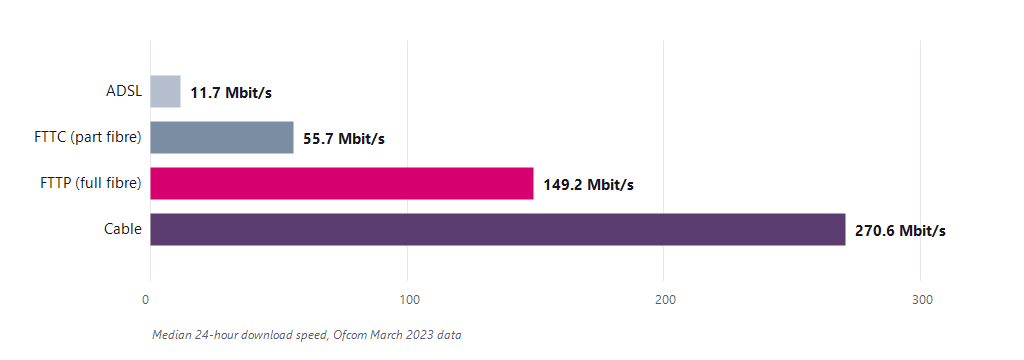
The average maximum download speed available to UK homes was 285 Mbit/s as of July 2025 (Ofcom Connected Nations 2025), up 28% on 2024. Northern Ireland leads the nations on 325 Mbit/s. Real-world median speeds vary sharply by technology: full fibre around 149 Mbit/s, cable around 271 Mbit/s, FTTC around 56 Mbit/s.
How many people have switched broadband using One Touch Switch?
More than two million homes have switched using One Touch Switch since the scheme launched in September 2024, with over 300 providers signed up via TOTSCo (Ofcom, to end 2025).
Are broadband complaints rising or falling?
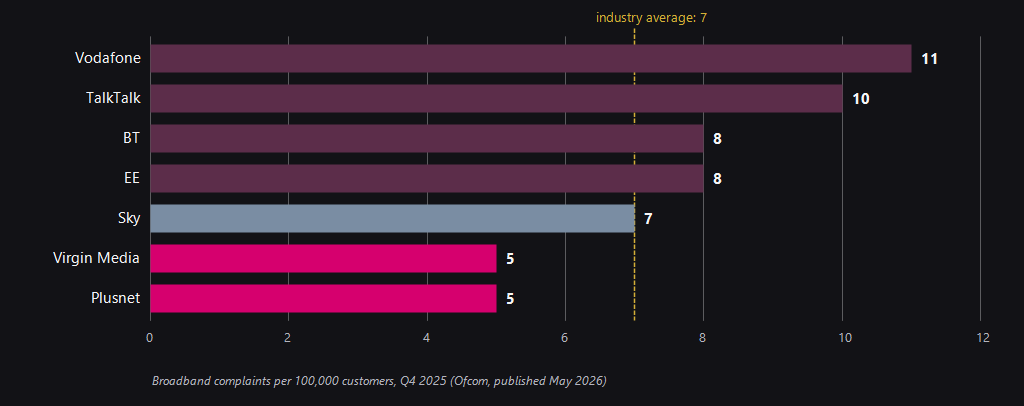
Complaints remain at historic lows. In Ofcom's Q4 2025 data the industry average was 7 complaints per 100,000 customers, with Vodafone (11) and TalkTalk (10) most complained-about and Virgin Media and Plusnet (both 5) fewest. See our full complaints league report for quarter-on-quarter detail.
When is the UK copper phone network being switched off?
Final PSTN switch-off is scheduled for 31 January 2027. As each exchange passes 75% full-fibre coverage, copper is withdrawn for new orders and legacy line costs are rising through 2026.
About this report
This report is part of the BroadbandSwitch.uk 2026 Guide Library, published by BroadbandSwitch.uk, the consumer arm of the SearchSwitchSave network. Coverage figures use Ofcom as the regulatory baseline and thinkbroadband as the live indicator; each is dated because the two legitimately differ. Our approach to evidence and corrections is documented in the methodology and trust hub, and every published correction appears in the corrections log.
Take it with you: download the free 6-page PDF report, including all charts, tables and full sources.
Citing this report: BroadbandSwitch.uk. (2026, June 11). UK broadband statistics 2026: The numbers, verified. SearchSwitchSave. https://broadbandswitch.uk/reports/uk-broadband-statistics/
Sources
- Ferguson, A. (2026, April). Exclusive April 2026 update on Openreach full-fibre roll-out. thinkbroadband. https://www.thinkbroadband.com/news/exclusive-april-2026-update-on-openreach-full-fibre-roll-out-2
- Independent Networks Co-operative Association. (2026). State of the altnets 2026. INCA. https://inca.coop/state-of-the-altnets-2026/
- Jackson, M. (2026, February). Ofcom find 532,000 UK consumers taking social broadband and mobile tariffs. ISPreview UK. https://www.ispreview.co.uk/index.php/2026/02/ofcom-find-532000-uk-homes-taking-social-broadband-and-mobile-tariffs.html
- Jackson, M. (2026, April). Ofcom raise UK consumer compensation payments for broadband ISP woes. ISPreview UK. https://www.ispreview.co.uk/index.php/2026/04/ofcom-raise-uk-consumer-compensation-payments-for-broadband-isp-woes.html
- Ofcom. (2025, November 19). Connected Nations UK report 2025. Office of Communications. https://www.ofcom.org.uk/phones-and-broadband/coverage-and-speeds/connected-nations-20252
- Ofcom. (2026). Connected Nations update: Spring 2026. Office of Communications. https://www.ofcom.org.uk/phones-and-broadband/coverage-and-speeds/connected-nations-update-spring-2026
- Ofcom. (2026, February 26). Pricing and consumer engagement: Trends in the UK communications sector. Office of Communications. https://www.ofcom.org.uk/phones-and-broadband/bills-and-charges/pricing-and-consumer-engagement
- Ofcom. (2026, February 19). Telecoms and pay-TV complaints (Q3 2025). Office of Communications. https://www.ofcom.org.uk/phones-and-broadband/service-quality/telecoms-and-pay-tv-complaints
- Office for National Statistics. (2024). Families and households in the UK: 2024. https://www.ons.gov.uk/peoplepopulationandcommunity/birthsdeathsandmarriages/families/bulletins/familiesandhouseholds/2024
- thinkbroadband. (2026). UK broadband map (live coverage tracker). https://labs.thinkbroadband.com/local/broadband-map
- Vodafone. (2026, May). 5G Broadband to deliver full-fibre-like speeds to 3.7m homes. https://www.vodafone.co.uk/newscentre/press-release/5g-for-home-broadband/
- VodafoneThree. (2025). VodafoneThree begins a new era of connectivity for the UK. https://www.vodafonethree.com/news/new-era-of-connectivity
National statistics describe the country, not your street. Coverage, speed and price all vary by address, so a postcode check at broadbandswitch.uk/compare is always the place to start. Ofcom figures are the regulatory baseline; live-tracker and operator figures are dated separately where they differ.